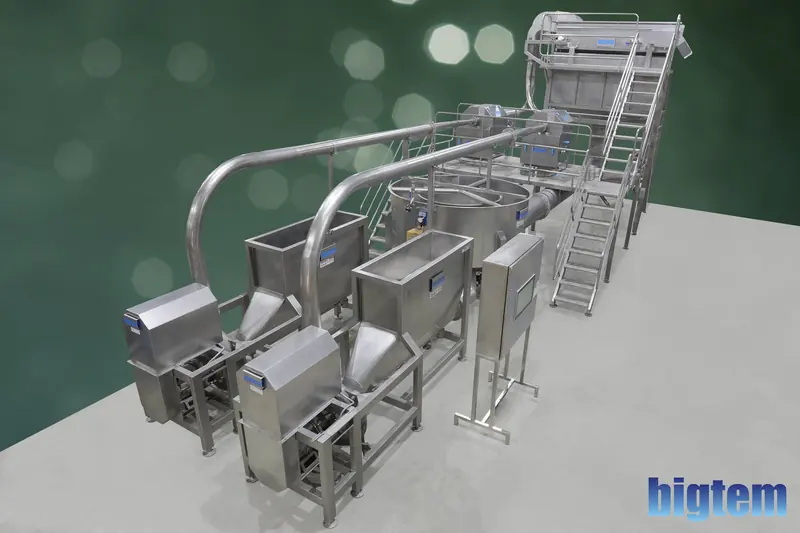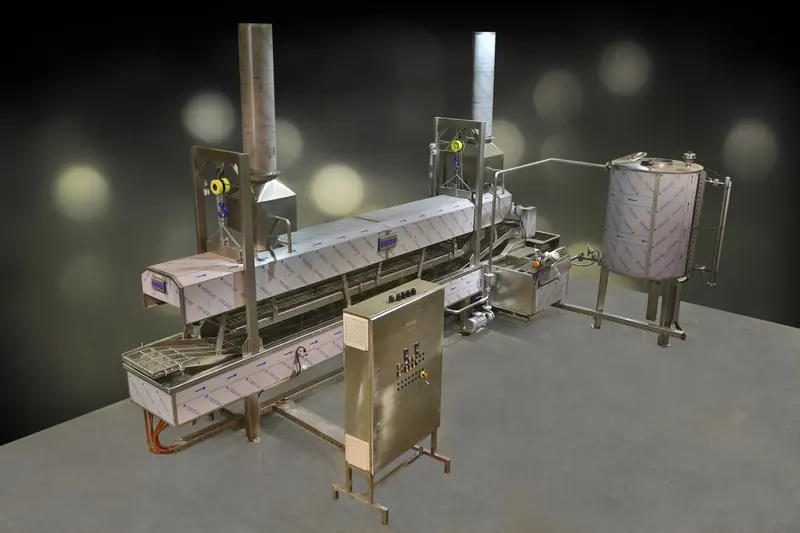
Potato & French fry lines

Potato & French Fry Processing Lines, from Receiving to IQF Freezing

Complete frozen and par-fried French fry lines designed, built and commissioned by Bigtem, from small to very large lines, sized to your plant. Buy the whole line or the modules your current line is missing.

French fry line process flow

Nine steps, one supplier, one capacity target. Select a step to see the machine.

French fry line process flowNine steps of a frozen French fry line: receiving and destoning, washing, steam peeling, water-knife cutting, two-stage blanching, belt drying, continuous frying, IQF freezing and packing.1Receiving& destoning2Washing& sorting3Steam peeling+ brush finish4Cuttingwater knife5Blanchingtwo stages6Dryingbelt dryer7Fryingcontinuous8Freezingpartner IQF9Packingweigh & packFrench fry line process flow1Receiving& destoning2Washing& sorting3Steam peeling+ brush finish4Cuttingwater knife5Blanchingtwo stages6Dryingbelt dryer7Fryingcontinuous8Freezingpartner IQF9Packingweigh & pack

Step by step through a Bigtem fry line

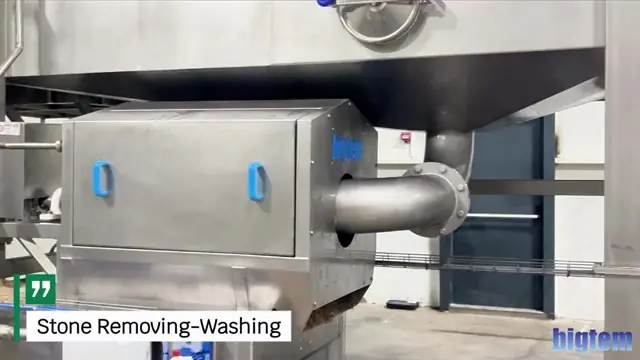
Stone removal and washing of raw potatoes
Step 1

Receiving, destoning & washing

Even feeding, stone removal and washing prepare raw potatoes for peeling. Where needed, an optical sorter integrated from a partner manufacturer, selected to fit your line, sorts the raw potatoes.

Equipment →
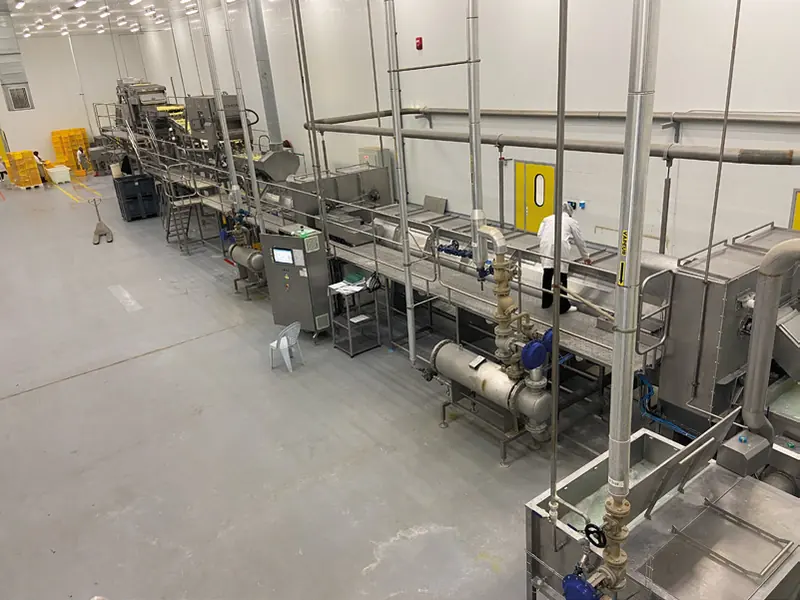
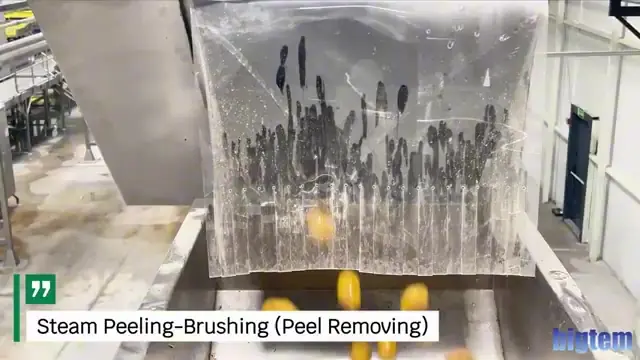
Steam peeling and brush peel removal in a French fry line
Step 2

Steam peeling & brush finishing

A DORUK steam peeler lifts the skin and a brush finisher removes it.

Equipment →
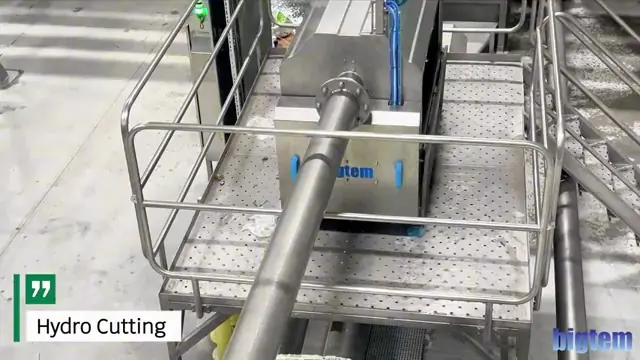
Hydro cutting section of a French fry line
Step 3

Water-knife cutting

Potatoes are pumped through the cutting head. A dual head switches automatically when a knife is dull or blocked.

Equipment →
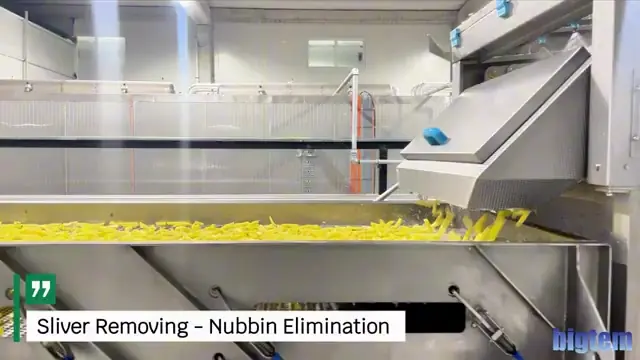
Sliver and nubbin removal after cutting
Step 4

Sliver & nubbin removal

Short pieces and slivers are separated after cutting, and inspection removes defects.

Equipment →
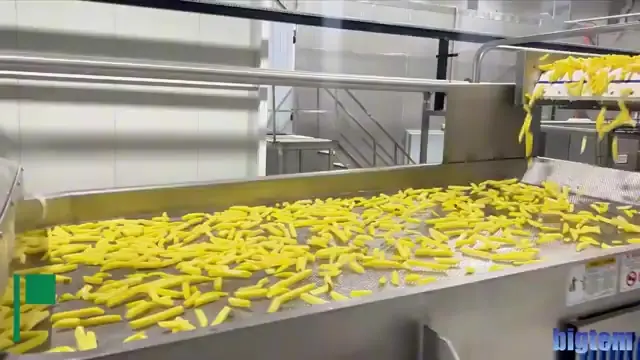
Two-stage blanching section of a French fry line
Step 5

Two-stage blanching

First stage for starch removal and color, second stage for cooking. Starch can be recovered from cutting and blanching water.

Equipment →
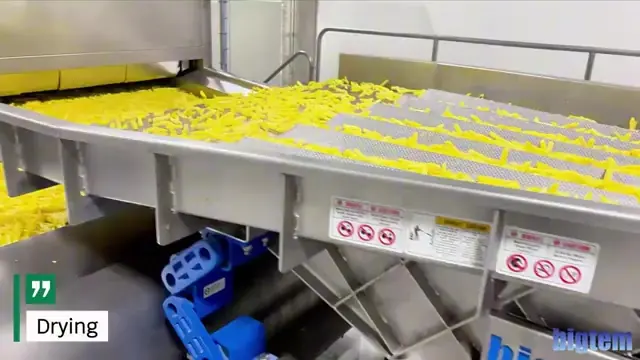
Fry strips entering the belt dryer
Step 6

Drying

A modular continuous belt dryer reduces surface moisture before frying.

Equipment →
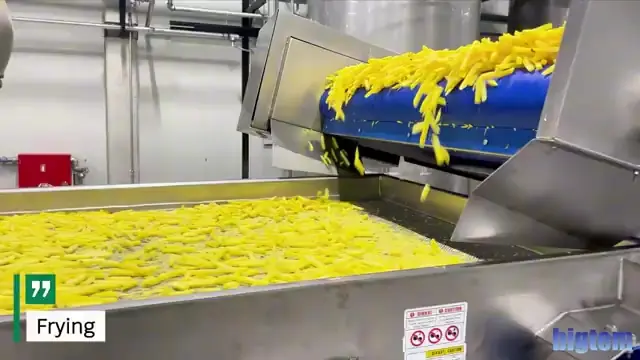
Par-fried strips leaving the continuous fryer
Step 7

Frying

A continuous fryer with precise temperature control, three-stage oil filtration, level control and fire protection.
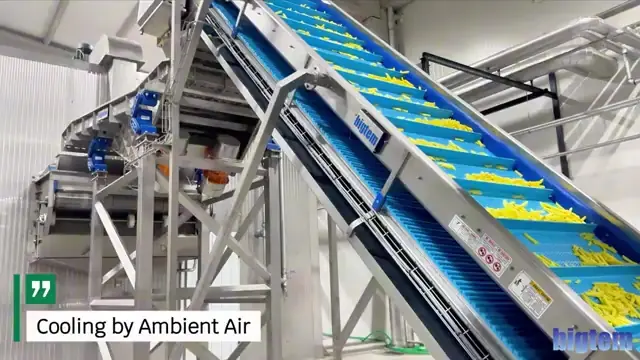
Fries on cooling conveyors before IQF freezing
Step 8

Cooling & IQF freezing

Fries cool on ambient-air conveyors, then freeze in an IQF freezer integrated from a partner manufacturer, selected to fit your line.

Equipment →
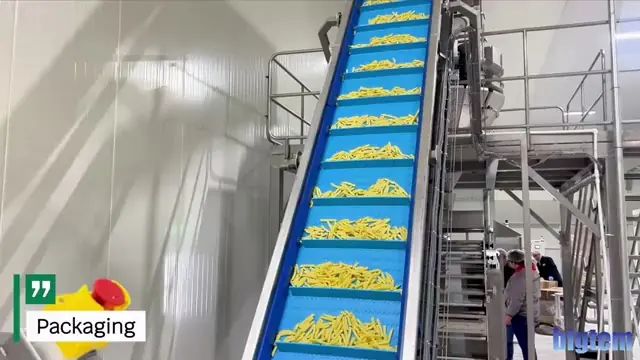
Frozen fries conveyed to packaging
Step 9

Grading & packing

Size grading, final inspection, weighing and packing, with box filling and palletizing options.

Still images from Bigtem’s French fry line footage.
What a complete line includes

  • Process engineering, plant layout and a utilities outline (steam, water, compressed air, power and fryer heating)
  • Every process machine from receiving to packing, matched to one output target
  • Interconnecting elevators, conveyors, turn tables and stainless steel service platforms
  • Electrical control panels with PLC and HMI per module, wired for the voltage you specify
  • Pressure vessels with US and Canadian certificates
  • Factory testing before shipment

See every machine in a French fry line, in order →

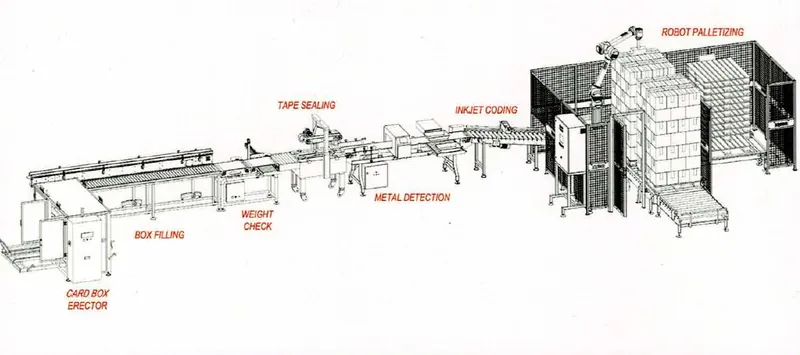
Drawing of a French fry end-of-line: box erecting, filling, weight check, sealing, metal detection, coding and robot palletizing
End of line: box erecting, filling, weight check, sealing, metal detection, coding and palletizing.

Small and starter French fry lines

A starter line uses the same process steps as a large plant, with fewer modules, a single lane and more manual work at the end of the line. It is laid out so that capacity and automation can be added without rebuilding the core.

  1. Feed & wash

    An even-feeding hopper and a combined drum washer and destoner.
  2. Peel

    One of the smaller DORUK steam peeler models with a brush finisher and a short inspection conveyor.
  3. Cut

    A water-knife cutting system with a sliver remover. Single-head to start; a dual head can be added.
  4. Blanch & dry

    A screw blancher, an air-knife feeder and a belt dryer with fewer modules.
  5. Fry & cool

    A continuous belt fryer with oil tank and filtration, followed by an ambient cooling section.
  6. Freeze & pack

    An IQF freezer integrated from a partner manufacturer, selected to fit your line, then manual box filling on a turn table with weight check, carton sealing and metal detection. Automated weighing, bagging and palletizing can be added later.

Lines are built from small to very large, sized to your plant. Tell us your target output, cut sizes and operating hours and we size each module to the same throughput.
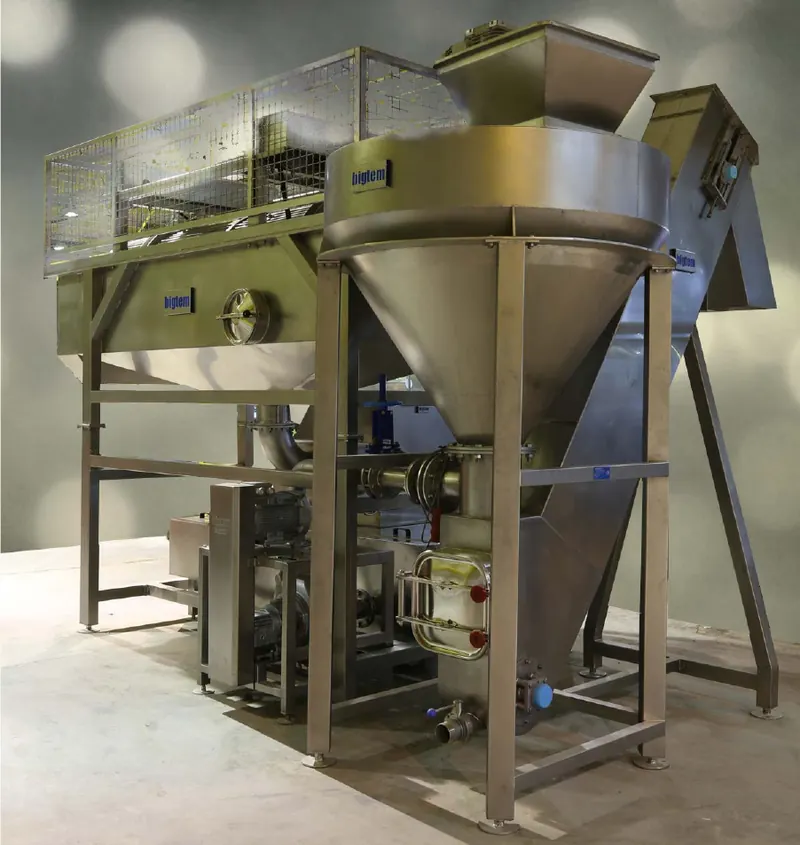
Bigtem drum washer with cyclone destoner for raw potatoes
Drum washer with cyclone destoner.
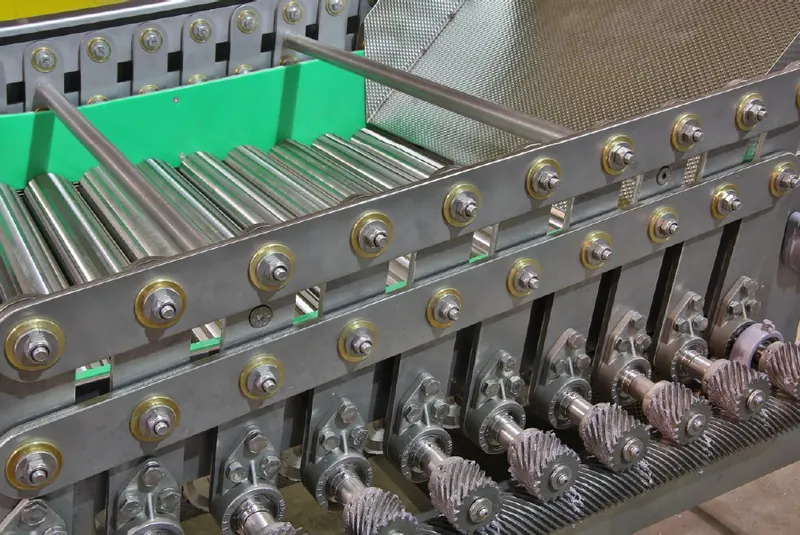
Bigtem sliver remover roller bed separating short pieces from French fry strips
Sliver remover after water-knife cutting.
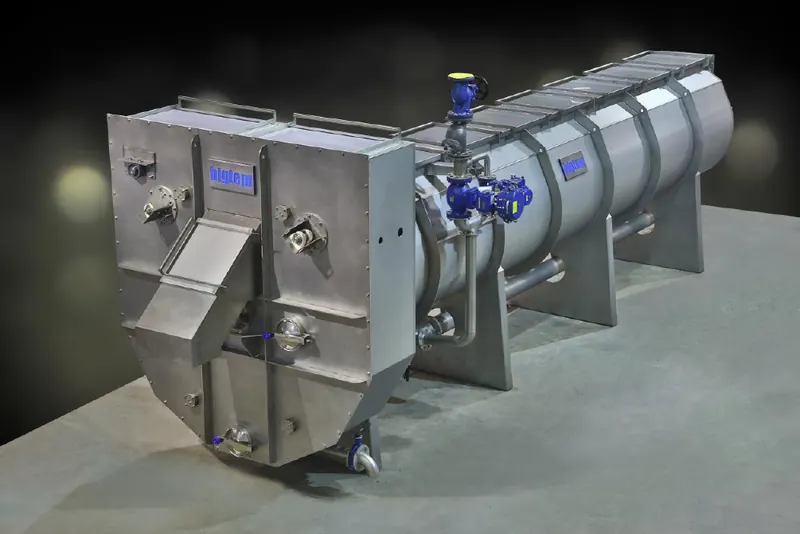
Bigtem screw-type dipping blancher for French fry strips
Screw blancher.
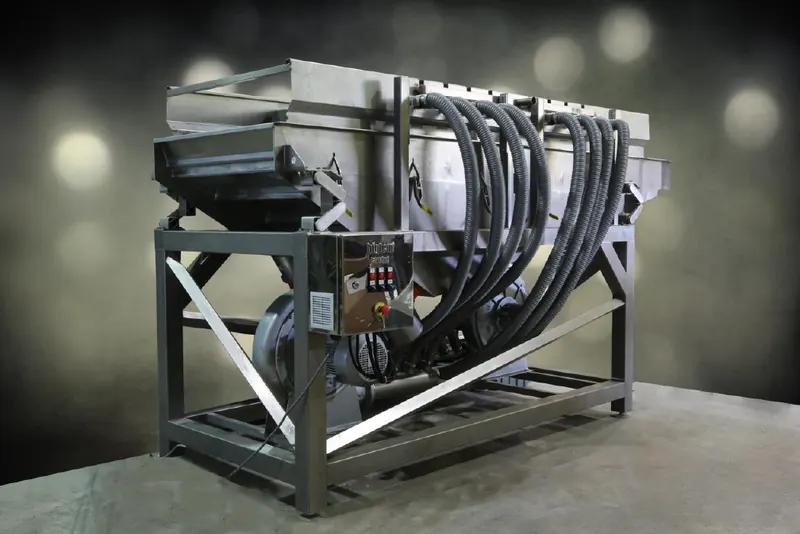
Bigtem vibrating feeder with air knife for removing surface water
Air-knife feeder ahead of the dryer.

Watch a fry line run

A Bigtem frozen French fry line from potato handling to IQF freezing and packaging, with each process step labeled. Video has no audio.
Bigtem USA short film on building a fry line as one line instead of a collection of machines.

Product forms

Controls

PLC and HMI control on each module, with SCADA integration, recipe control and line synchronization. Remote access is available where the line is configured for it.
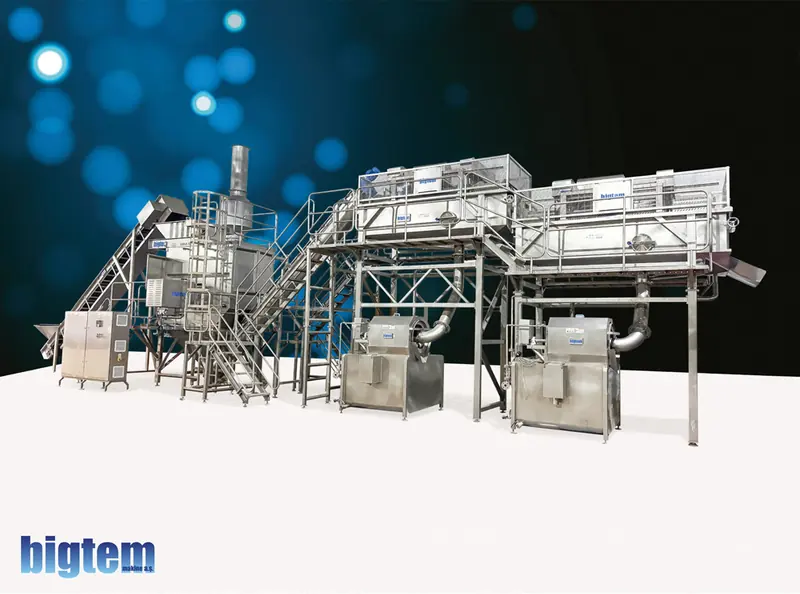
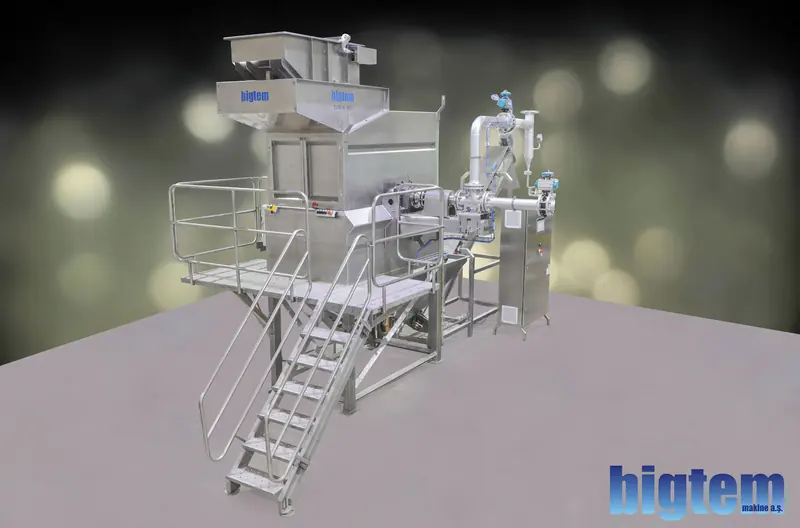
3D layout of a Bigtem frozen French fry production line
3D layout of a Bigtem frozen French fry line.
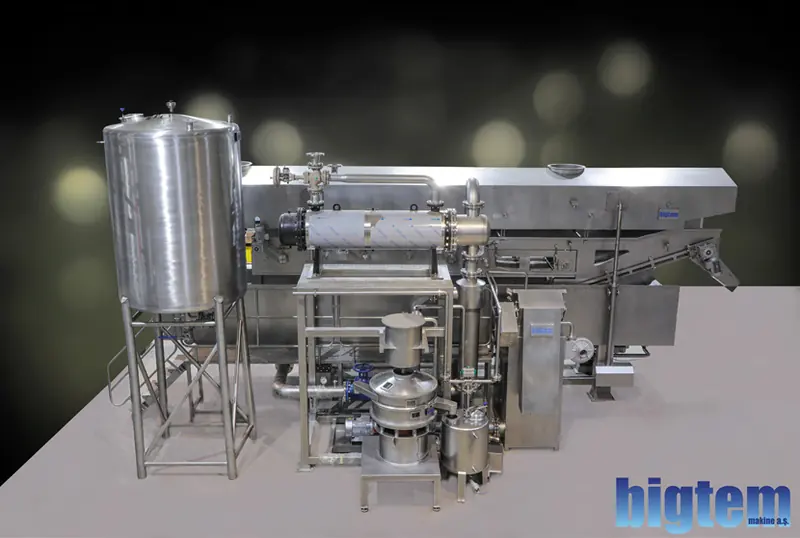
Bigtem continuous French fry fryer with oil filtration system
Continuous fryer with oil filtration.

Modules you can buy on their own

Bigtem hydrocutter water-knife cutting system with pump and feed tank

Hydrocutter

Water-knife cutting with a dual, auto-switching head.
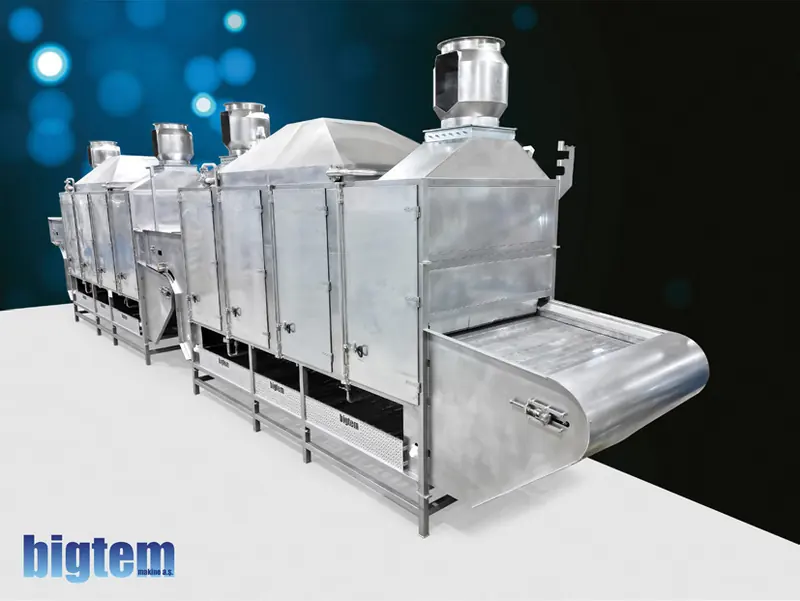
Bigtem modular continuous belt dryer for French fry strips

Belt dryer

Modular continuous dryer ahead of the fryer.

Two-stage blanching section of a French fry line

Blanchers

Two-stage blanching for starch removal, color and cooking.
Plan your line

  1. Define output

    Finished-product output, cut sizes, product mix and operating hours.
  2. Review utilities

    Steam, water, compressed air, power and fryer heating available at your site.
  3. Lay out the flow

    Receiving to packing, in sequence, with service access and sanitation in mind.
  4. Configure & quote

    A line proposal with a layout and utilities outline. No prices are published.

Read the French fry line layout guide →

Build your equipment ROI case with the free ProcessorROI calculator. A free online tool for rough labor, yield, energy and payback estimates you can bring to a capex meeting. Enter your own plant numbers.

Open the ProcessorROI calculator (external site, opens in a new tab) ↗

Market context

North American potato processing keeps growing

Processors are adding and modernizing lines, and the equipment behind that tonnage has to keep up.

286.1 million cwtUS potatoes used by processors from the 2025 crop, up from 2024.
159.7 million cwtof that went to frozen French fries, the largest single use.
58.3 million cwtwent to chips and shoestrings, and 42.1 million cwt to dehydrated products.
125.8 million cwtCanada’s 2025 crop. Alberta planted more potatoes “on account of increased processing capacity.”

Sources: USDA NASS, Potatoes 2025 Summary (US figures); Statistics Canada, December 2025 release (Canadian figures and quote). 1 cwt = 100 lb.

French fry line questions

What makes up a small or starter fry line?

The same core steps as a large plant with fewer modules: one feed lane, a smaller DORUK steam peeler, water-knife cutting with sliver removal, a screw blancher, a shorter belt dryer, a continuous fryer, cooling and freezing, and manual packing that can be automated later.

What capacities are available?

Bigtem builds fry lines from small to very large, sized to your plant. Tell us your target finished-product output, cut sizes and operating hours, and we size every module to the same throughput.

Can you supply only some modules for an existing line?

Yes. Steam peelers, hydrocutters, blanchers, dryers, fryers and washers are sold on their own and matched to the equipment you keep.

What utilities does a fry line need?

Steam, process water, compressed air, electrical power and, for the fryer, a heating source and exhaust. We prepare a utilities outline for your configuration.

Which voltages can you build to?

Any voltage the customer specifies, for example 480V/60Hz or 575V/60Hz.

Do you install and train in North America?

Yes. Installation supervision, start-up, operator and maintenance training, and parts support are coordinated from Atlanta.

Can the line handle sweet potatoes?

Yes. Sweet potato fries use the same core steps. Peeling and blanching settings are adjusted to the crop.

Request a fry line layout study

Share your target output, cut sizes, operating hours and site utilities. We size every module to the same throughput and send a layout and utilities outline.