
Industrial Garlic Peeling Line: Dry Airblast Peel
Bigtem builds a dry airblast garlic peeling line for drying, freezing or packing. Each peeler runs about 550 lb/h (~250 kg/h) on average, depending on garlic variety (some varieties are softer than others). Standard lines are based on 1 t/h or 2 t/h (about 2,200 or 4,400 lb/h) of garlic infeed and can be expanded with additional equipment for higher capacity.
- Dry blast-air peel after clove separation and conditioning
- Each peeler: about 550 lb/h (~250 kg/h) on average, depending on garlic variety
- Standard lines: 1 t/h or 2 t/h (about 2,200 or 4,400 lb/h); expand with additional equipment for higher capacity
- North American sales, engineering and parts & service from Bigtem USA in Atlanta — (770) 999-0587
RFQ shortcut: Multi-peeler line · Multi-peeler diagram · Utilities · Parts & service
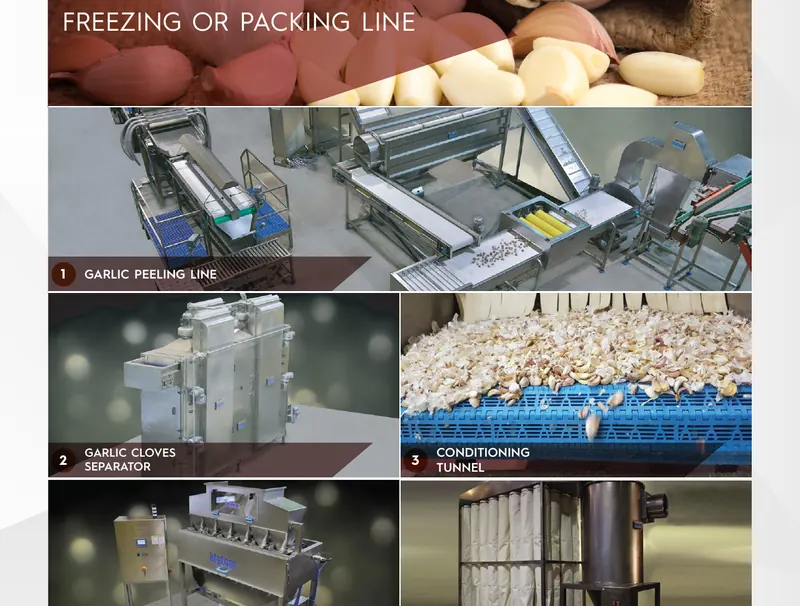
Garlic peeling line at a glance
Extractable stage list from the Bigtem garlic peeling line brochure. Each peeler runs about 550 lb/h (~250 kg/h) on average, depending on garlic variety; standard lines are based on 1 or 2 t/h (about 2,200 or 4,400 lb/h) and expand with additional equipment.
| Stage | What happens | Group |
|---|---|---|
| 1. Bin dump & even feed | Automatic bin dumping and even feeding of whole garlic bulbs into the line. | Receiving |
| 2. Cracking | Bulbs are cracked so cloves can be separated. | Preparation |
| 3. Clove separation | Cloves are separated; sifting and aspiration remove skins, over-grades and twins. | Preparation |
| 4. Conditioning tunnel | Cloves are conditioned ahead of dry peel so skins release cleanly. | Conditioning |
| 5. Blast-air peeler | Portioned cloves are peeled with dry blast air (airblast peeler). | Peeling |
| 6. Dust aspiration | Dust suction / aspiration removes loose skins and fines after peeling. | Cleaning |
| 7. Wash, dewater, inspect (options) | Optional vortex washing, dewatering, inspection and size grading. | Finishing |
| 8. Pack, dry or freeze (options) | Weight/fill, bag sealing, case erecting, or transfer to drying or freezing. | Downstream |
| Published capacity | Per peeler: about 550 lb/h (~250 kg/h) on average, depending on garlic variety (some are softer than others). Standard lines: 1 t/h or 2 t/h (about 2,200 or 4,400 lb/h) of garlic infeed. Higher plant targets: add equipment (more peelers in parallel, matching shared modules). Final sizing confirmed with your bulb data. | |
Multi-peeler line: expanding throughput
Each garlic peeler runs about 550 lb/h (~250 kg/h) on average, depending on garlic variety. Standard lines are based on 1 t/h or 2 t/h (about 2,200 or 4,400 lb/h). Higher plant targets are met by adding equipment — more peelers in parallel, with shared upstream and downstream modules sized to match.
Final peeler count and shared module sizes depend on bulb data, hours and peel target — confirmed on quote. Send target lb/h to request a quote or call (770) 999-0587.
Utilities for a garlic peeling line
Figures below come from the Bigtem brochure. Air pressure, airflow and power are confirmed with the layout on quote.
| Utility | What we can say on the site | Source |
|---|---|---|
| Compressed air | Required for dry blast-air peeling (brochure: blast air / portioning blast peeler). Exact pressure and compressor size are not printed on EN-04/19 — sized with the layout on quote. | Brochure stages |
| Electrical power | Motors and controls for separators, conditioner, peeler(s), aspiration and conveyors. Plant voltage confirmed with the layout on quote. | Implied by industrial line; confirm on quote |
| Water | Only if optional vortex wash / dewater modules are included. Dry peel step itself does not use wash water. | Brochure optional wash/dewater |
| Dust aspiration | Dust suction / aspiration after blast peel is part of the brochure line flow. | Brochure stage |
HQ gap: brochure EN-04/19 does not print air pressure (bar), compressor size or installed kW. Ask Bigtem USA for the data sheet with your quote.
How dry airblast garlic peeling works
Whole bulbs are cracked and cloves are separated, conditioned, then peeled with dry blast air so the clove stays intact for drying, freezing or packing.
Bigtem USA short film (44 s, with voice-over): wet peel vs dry airblast, the line stages, and line capacity.
Video transcript
Most garlic plants still peel wet, and wet peeling adds water to cloves that you then have to manage. The Bigtem line peels dry, with blast air, for drying, freezing, or packing lines. Bulbs go in, get cracked and separated, conditioned, then hit the airblast peeler. Skins off, cloves intact. Each peeler does about 550 pounds an hour. Standard lines run one to two tons an hour and expand. Dan Ghadiri, Bigtem USA, in Atlanta. We're the North American operation of Bigtem. If industrial garlic peel is on your list, I'll come look at your plant.
- Clove separator and conditioning tunnel ahead of the peeler
- Blast-air peeler with portioning and dust aspiration
- Optional wash, inspection, grading and packing modules
HQ factory demo of a Bigtem dry airblast garlic peeling line (YouTube original).
- Clove separator and conditioning tunnel ahead of the peeler
- Blast-air peeler with portioning and dust aspiration
- Optional wash, inspection, grading and packing modules
Where the line fits
- Peeled garlic for drying and dehydration
- Peeled garlic for IQF freezing
- Fresh peeled cloves for packing
- Allium plants that also run onion top-and-tail and drying
Onions & garlic applications · Drying & dehydration · All peeling systems
What we need for a quote
- Target lb/h for the line — standard lines are 1 or 2 t/h (about 2,200 or 4,400 lb/h); tell us if you need more
- Bulb size / variety and peel target (variety affects the per-peeler rate of about 550 lb/h)
- Dry only, wash pack, freeze, or dehydrate downstream
- Plant voltage and compressed-air availability (pressure sized on quote)
- Footprint and infeed (bins, bags, totes)
Request a quote call (770) 999-0587
North American parts & service: coordinated by Bigtem USA in Atlanta. Parts & service · (770) 999-0587 · Request spare parts
Garlic peeling line questions
What capacity is the Bigtem garlic peeling line?
Each Bigtem garlic peeler runs about 550 lb/h (~250 kg/h) on average, depending on garlic variety — some varieties are softer than others. Standard garlic lines are based on 1 t/h or 2 t/h (about 2,200 or 4,400 lb/h) of garlic infeed and can be expanded with additional equipment for higher capacity. A single peeler does not do 1 t/h; line capacity comes from several peelers plus shared upstream and downstream stages. Final sizing is confirmed with your bulb data, variety, moisture and peel target.
Can a garlic line go above 2 t/h?
Yes. Standard lines are based on 1 or 2 t/h (about 2,200 or 4,400 lb/h); higher plant targets are met by adding equipment — more peelers in parallel with matching upstream and downstream modules. Shared upstream (crack / separate / condition) and downstream modules are sized to match. See the multi-peeler line block and diagram on this page. Tell us your target lb/h and we size the line.
How does Bigtem dry airblast compare with low-cost dry pneumatic garlic lines?
Both approaches are dry / pneumatic. Bigtem positions an engineered line (clove separation, conditioning tunnel, blast-air peel, dust aspiration, optional wash/pack/dry/freeze modules) with North American sales, layout engineering and parts & service from Atlanta — not a bare peeler-only import. We do not publish competitor brand names or their claimed capacities on this site; ask us for a side-by-side on your target lb/h, utilities and support needs.
What utilities does the garlic line need?
Brochure stages show dry blast-air peeling (compressed air + electrical power). Water appears only if optional wash / dewater modules are added. Exact air pressure, compressor size and kW are not printed on brochure EN-04/19 — they are sized with the layout on quote. See the utilities table.
What are the main stages of the line?
Typical flow from the brochure: bin dumping and even feeding, cracking, clove separation with sifting and aspiration, conditioning tunnel, blast-air peeler with portioning, dust aspiration, then optional vortex washing, dewatering, inspection, grading, and packing or drying/freezing.
Can the line feed drying or freezing?
Yes. The brochure titles the line for drying, freezing or packing. Downstream modules (wash/dewater, inspection, weight/fill, bag sealing, case erecting) are selected for the finished product.
Do you publish model numbers or air pressure specs?
Not on this page beyond the capacity standard above (about 550 lb/h per peeler; standard lines of 1 or 2 t/h). Ask for the data sheet with your quote; we size compressed air, power and layout to your plant.
Parts and service in North America?
Yes. Spare parts, wear parts, commissioning support and service for Bigtem lines are coordinated by Bigtem USA from Atlanta. Call (770) 999-0587 or use Parts & service / the spare parts request form.
Is there a Bigtem USA garlic video?
Yes. The Bigtem USA short film (44 s) on this page shows the dry airblast line: bulbs are cracked and separated, conditioned, then the airblast peeler takes the skins off and leaves cloves intact. A full transcript is below the video, and the HQ factory demo (YouTube) is kept alongside it.
Why peel garlic dry instead of wet?
As the Bigtem USA video puts it, wet peeling adds water to cloves that you then have to manage. The Bigtem line peels dry, with blast air, for drying, freezing or packing lines; wash or grade modules are optional after the peel step.
Related: Peeling systems · Onions & garlic · Drying & dehydration · Other peelers · Parts & service · Request a quote
Size a garlic peeling line
Send target lb/h, bulb data and whether you dry, freeze or pack. We size a standard 1 or 2 t/h line (about 2,200 or 4,400 lb/h) or expand it with additional equipment, and outline utilities.