
Applications · Onions & Garlic
Onion and Garlic Processing Equipment
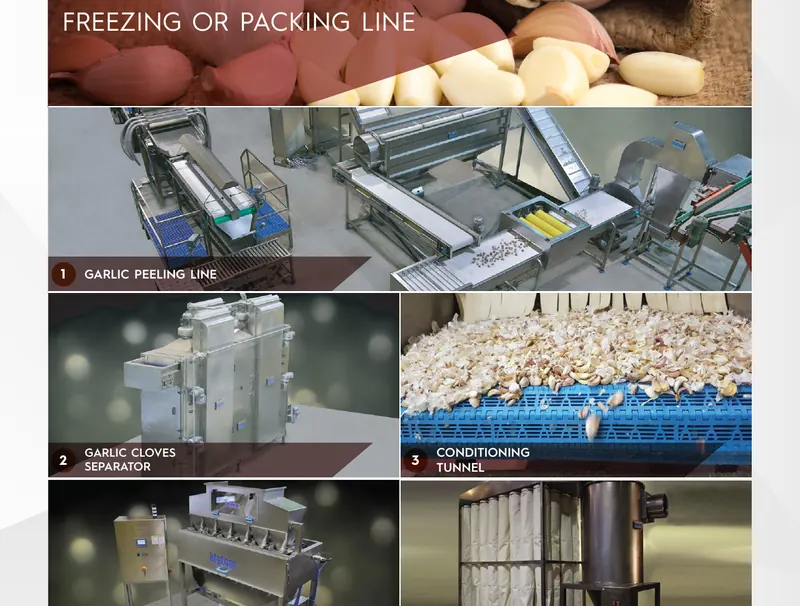
Onion top and tail machines, peeling, inspection, slicing and dicing, drying and packing, plus a dedicated dry airblast garlic peeling line (about 550 lb/h per peeler, variety-dependent; standard lines 1 or 2 t/h, about 2,200 or 4,400 lb/h, expandable).
Typical process for onions & garlic
Equipment for onions & garlic
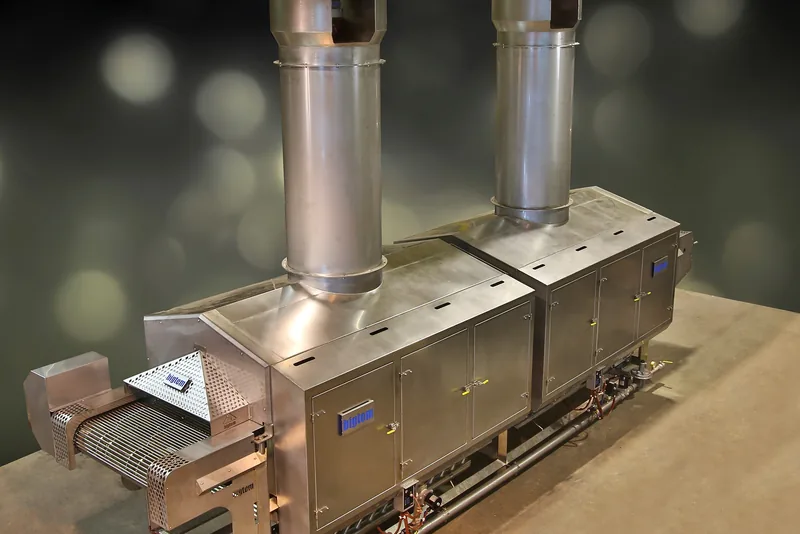
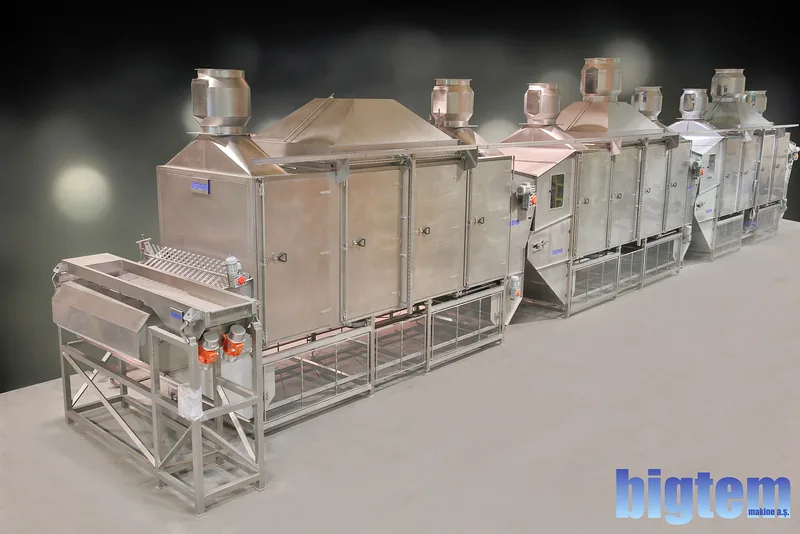
Onion and garlic equipment at a glance
| Equipment | Role on an onion or garlic line | Published capacity |
|---|---|---|
| Garlic peeling line (dry airblast) | Clove separation, conditioning tunnel, blast-air peel and dust aspiration; no steam | About 550 lb/h (~250 kg/h) per peeler on average, depending on garlic variety; standard lines 1 or 2 t/h (about 2,200 or 4,400 lb/h), expandable with additional equipment |
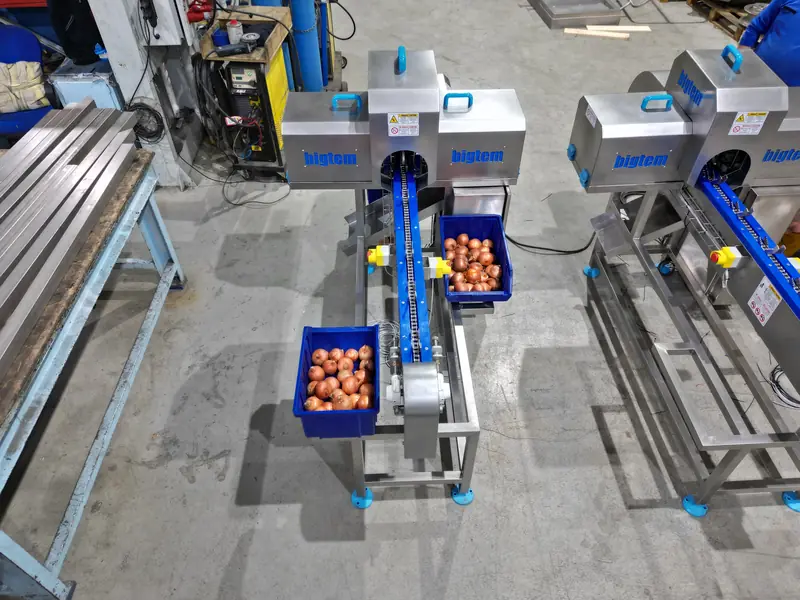
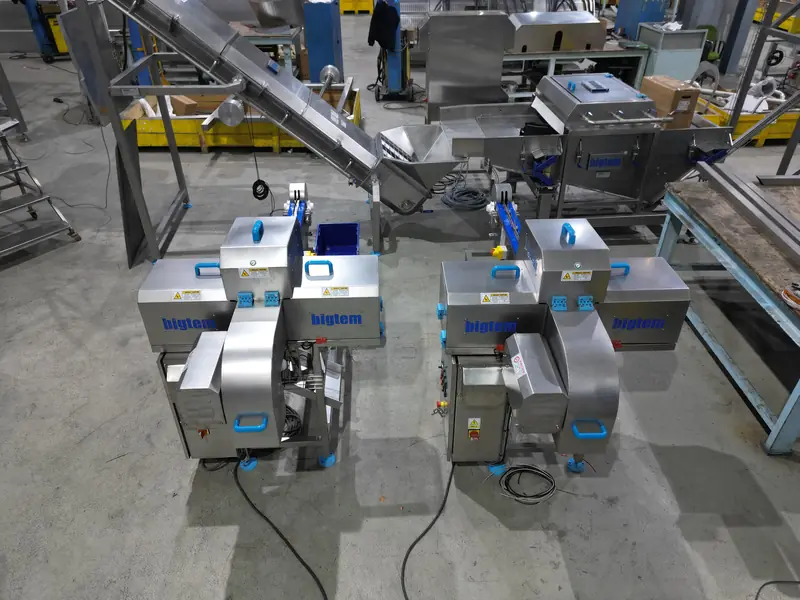
| Onion top and tail machines | Automatic top and root cutting ahead of peeling, with feed, discharge and waste conveyors | Sized per project; two or more machines run side by side for higher volumes |
| Abrasive roller peeler | Continuous abrasive peeling after top and tail; power and water, no steam | Up to about 11,000 lb/h (5 t/h) max; recommended up to about 4,400 lb/h (2 t/h) |
| Onion air peeling and batch peelers | Air peeling or batch abrasive peeling, chosen by product | Sized per project |
| Heat radiation roasting tunnel | Onion flame peeling and fire-roasted flavor | Sized per project; gas from about 30 m³/h natural gas at 300 mbar per tunnel |
| Drying lines | Washing, slicing, multi-zone belt drying, cooling and packing for dried onion and garlic | Sized per project |
Garlic figures are garlic infeed. A single garlic peeler does not do 1 t/h; line capacity comes from several peelers plus shared upstream and downstream equipment. Onion rates depend on bulb size and variety, so we size them with your data.
Plan your line
Tell us your product, volume and what you make today. A Bigtem USA engineer recommends a configuration and a utilities outline.
Onions & Garlic questions
How is garlic peeled?
Bigtem uses a dry airblast garlic peeling line: clove separation, conditioning tunnel, blast-air peel and dust aspiration. Each peeler runs about 550 lb/h (~250 kg/h) on average, depending on garlic variety; standard lines are based on 1 or 2 t/h (about 2,200 or 4,400 lb/h) and can be expanded with additional equipment. See the garlic peeling line page.
Can onions be flame peeled?
Yes. The heat radiation roasting tunnel is also used for onion flame peeling.
Do you build dried onion and garlic lines?
Yes: washing, slicing, multi-zone belt drying, cooling and packing. Peeled garlic from the airblast line can feed drying or freezing.
What capacity is a Bigtem garlic peeling line?
Each peeler runs about 550 lb/h (~250 kg/h) on average, depending on garlic variety. Standard lines are 1 or 2 t/h (about 2,200 or 4,400 lb/h) of garlic infeed and are expanded with additional peelers and equipment for higher targets.
Why top and tail onions before peeling?
Cutting both ends first exposes the outer skin layers, so peeling is faster and more uniform with less product loss. See onion top and tail machines.
Related: All applications · Request a quote
Tell us your crop, capacity and timeline
A Bigtem USA engineer will review your project and follow up with a recommended configuration and a utilities outline.