
Is Cleaning Your Real Bottleneck? Sanitation Downtime and Hygienic Design
Third shift can’t finish. Product is still sitting in the washer bath at cleanout. The machine isn’t the slowest thing on the line; the cleanout is.
Bigtem USA engineering guide · updated October 2026
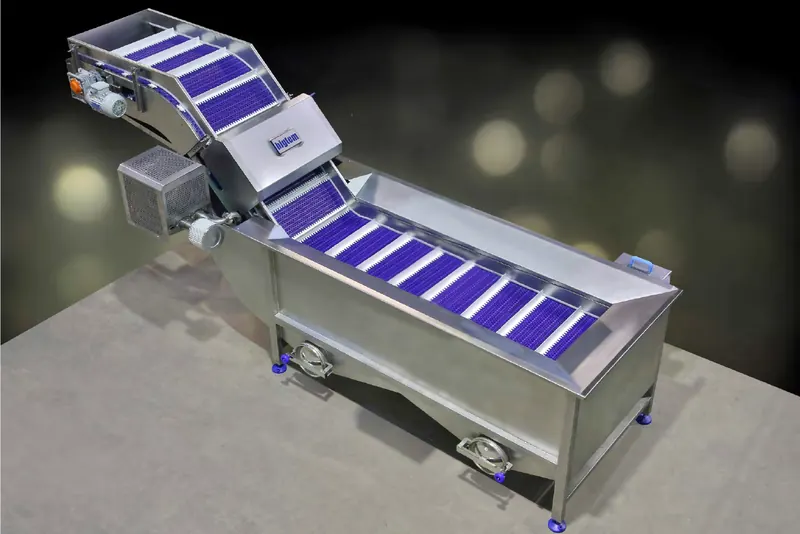
By Dan Ghadiri, Bigtem USA
- Sanitation downtime is lost production: count it from last good product to first good product.
- Most cleaning time goes to trapped product, drain-down and access, not scrubbing.
- Ask how each machine empties, drains and opens before you buy it.
Measure the cleanout
Time one cleanout step by step: stop, empty, drain, open, clean, close, inspect, restart. Write down where the crew waits. The longest steps are usually the same every night.
Where cleaning time goes
Product trapped in baths
Washer and blancher baths that hold product at the stop have to be emptied by hand before cleaning starts.Slow drain-down
Water and soil that drain slowly, or settle where nobody can reach, add time at every cleanout.Belt returns and transfers
Product hangs up on belt returns, flume corners, hoppers and under guards.Tools to open
Guards and covers that need tools slow the crew and tempt shortcuts with guards off.Floor splash
Machines low to the floor get splashed during cleaning and are harder to clean underneath.Restart and inspection
The line waits for inspection and warm-up before first good product.
What to ask for in the machine
- A clear discharge path so product leaves the washer or blancher bath instead of staying in it — see washers & destoners
- Stainless steel product contact and access to belts and screws for inspection — see blanchers
- Water filtration that keeps soil and peel out of recirculated water — abrasive peelers offer spray cleaning and optional peel water filtration (abrasive peeler); tomato reception lines include water filtration and circulation (tomato lines)
- Temperature shown and controlled on the PLC and HMI, so the blancher reading is on record for your food safety plan
- Hinged guards with safety switches where the design allows, instead of covers that need tools
- Room around and under the machine to clean, planned in the line layout — see the line layout guide
Plant checklist
- Drain-down time per machine
- Every point where product is still sitting after a stop
- Which guards and covers need tools
- Height off the floor and splash zones
- Spare belt and wear parts on site
- Time from end of cleaning to first good product
Send us a photo of the machine that takes longest to clean, and we’ll tell you where the time goes.
Sanitation downtime: FAQ
How do I reduce sanitation downtime in a food plant?
Time the cleanout from last good product to first good product, then attack the longest steps: drain-down, product trapped in baths and belt returns, guards that need tools, and inspection holds before restart.
What causes long washer cleanouts?
Product that stays in the bath when the line stops, slow draining and soil that settles where it cannot be reached. Ask how the bath empties, where product discharges and how the operator reaches the bottom.
What should a hygienic blancher look like?
Stainless steel product contact, a clear path to empty water and product, access to the belt or screw for inspection, and temperature control. Bigtem screw and drum blanchers run up to 95 °C (203 °F); drum blanchers heat indirectly through a plate heat exchanger with a digital thermostat. See blanchers.
How do I record blancher temperature for FSMA?
Your food safety plan sets what to record and verify. On the equipment side, ask for PLC and HMI control so temperature is displayed and can be logged, and agree with your team how a low temperature is handled at the line.
Where does product hang up in a vegetable line?
Usually at transfers: washer discharges, belt returns, flume corners, hoppers and under guards. Walk the line after a stop and mark every place product is still sitting.
Does washer water filtration help cleaning?
It keeps soil and peel out of the recirculated water, so less settles in the machine. Abrasive peelers can be fitted with peel water filtration, and tomato reception lines include water filtration and circulation.
Related: Washers & destoners · Blanchers · How to choose a blancher · Abrasive peeler · Tomato reception lines · Production bottleneck
Send us your longest cleanout
A photo of the machine and how long cleaning takes is enough to start.